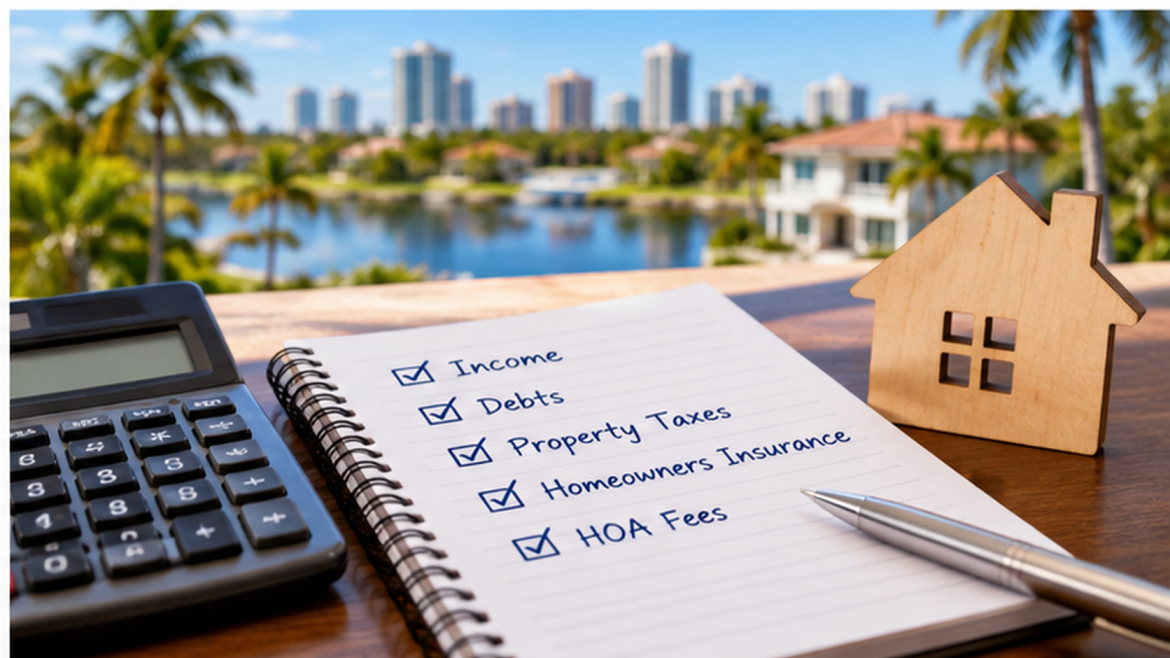
Most buyers start with a price in mind, but a lender starts with a different number: how much of your monthly income can go toward debt. In Florida, the house payment is only part of the picture. Property taxes, homeowners insurance, possible flood insurance, association dues and mortgage insurance all count toward what you can borrow.
This guide shows how lenders measure what you can afford, the published debt-to-income guidelines for conventional, FHA, VA and USDA loans, and the Florida costs that can change your numbers. It is general education, not a loan approval, so use it to prepare for a conversation with a lender.
Want to Know Your Real Budget?
Greg Hayden can review your income, debts, down payment and the Florida costs on your target home, show how the main loan programs may treat your numbers, and compare options from more than 25 wholesale lenders.
How Lenders Measure What You Can Afford
The main measure is your debt-to-income ratio, or DTI. The Consumer Financial Protection Bureau defines it as your total monthly debt payments divided by your gross monthly income, which is your income before taxes. Your new mortgage payment is counted as one of those debts. See the CFPB’s explanation of debt-to-income ratios.
For the monthly housing payment, Fannie Mae counts principal and interest, property insurance, flood and mortgage insurance where they apply, real estate taxes, special assessments and owners’ association dues. Your other debts are added on top, including installment and mortgage debts lasting more than ten months, revolving debts such as credit cards, lease payments, and certain alimony or support payments. See Fannie Mae’s rules on monthly housing expense and debt-to-income ratios. Everyday living costs such as groceries and utilities are not debts in this calculation, but they still matter to your budget.
Published DTI Guidelines by Loan Program
| Program | Published qualifying guideline | What to know |
|---|---|---|
| Conventional (Fannie Mae) | Total DTI up to 36% for manually underwritten loans, or up to 45% if credit score and reserve requirements are met. Loans approved through Desktop Underwriter can go up to 50%. | Automated approval looks at the whole file, so a higher DTI is possible with strong credit, reserves and other factors. |
| FHA | For manually underwritten loans, 31% housing and 43% total DTI. With compensating factors and a score of 580 or higher, 37/47 or 40/50 may be allowed. | Compensating factors include cash reserves, a minimal increase in housing payment, residual income, or no discretionary debt. Automated approvals can differ. |
| VA | A 41% debt-to-income ratio is a guide, not a hard cutoff. | VA also requires enough residual income, which is the money left each month after debts, taxes and living costs. A ratio over 41% gets closer scrutiny unless residual income is strong. |
| USDA | 29% housing and 41% total debt. A ratio waiver can allow up to 32% housing and up to 44% total debt, for example with a GUS Accept recommendation, or with a 680+ credit score and a qualifying compensating factor. | The higher ratios generally need a credit score of 680 or higher and a compensating factor when the loan is not a GUS Accept. |
These summaries come from Fannie Mae’s Selling Guide, HUD’s FHA qualifying ratio guidance, VA’s Lender’s Handbook (Chapter 4) and the USDA Handbook (HB-1-3555, Chapter 11). These are maximums, not targets, and individual lenders can set stricter limits. Programs change, so confirm the current rules with a lender.
A Simple Example
Here is how the math works for a hypothetical buyer with $8,000 of gross monthly income and $600 of other monthly debts, such as a car payment and student loan. This is an illustration only. It is not a quote or a recommendation to borrow the maximum.
| If your maximum ratio is | Total monthly debts allowed | Left for the housing payment after $600 of other debts |
|---|---|---|
| FHA manual baseline: 31% housing and 43% total | $3,440 total, with housing capped at 31% ($2,480) | $2,480 (the 31% housing cap is the limit) |
| Conventional manual at 45% total | $3,600 | $3,000 |
| Conventional automated at 50% total | $4,000 | $3,400 |
Next, the housing payment has to cover all of the pieces, not only principal and interest. The loan amount and interest rate set the first part. Taxes, insurance, mortgage insurance and association dues take up the rest. A home with lower taxes and insurance may allow a higher price at the same payment. You can test different scenarios with our mortgage calculator.
Florida Costs That Change the Math
Property taxes. Florida homeowners may qualify for a homestead exemption. In Palm Beach County, the first $25,000 of assessed value is exempt from all taxes, and an additional inflation-indexed exemption applies to non-school taxes when assessed value is $50,000 or more. Applications are due by March 1, and you generally must make the home your permanent residence as of January 1. See the Palm Beach County Property Appraiser’s homestead page. Once you have an exemption, the Save Our Homes cap limits annual increases in assessed value to the lower of 3% or the change in the consumer price index, which was 2.7% for 2026 according to the Florida Department of Revenue. Because exemptions and capped values depend on the owner, a seller’s current tax bill may not predict yours, so ask your lender or the county property appraiser for an estimate based on the purchase price.
Florida voters will also decide Amendment 3 on the November 2026 ballot, which would raise the homestead exemption for non-school property taxes beginning in 2027 if approved. It is not law unless it passes, so check the results and ask how any change would affect your estimate.
Homeowners insurance. Wind and hurricane coverage can be a major monthly and annual cost in Florida. Florida’s hurricane deductible is separate from the standard deductible and is often a percentage of your dwelling coverage, with insurers generally required to offer options such as 2%, 5% and 10%. The state describes how it works on the Florida Department of Financial Services website. Get insurance quotes before you finalize a budget. Our guides to homeowners insurance and mortgage approval and to insurance, taxes and HOA costs go deeper.
Flood insurance. Flood coverage is added to a homeowners policy by endorsement or bought as a separate policy, and most Florida flood policies are written through the National Flood Insurance Program. A 30-day waiting period generally applies to new policies, but not when the purchase is tied to a loan. Check the property’s flood zone early, because the premium can change the payment. See the state’s flood insurance overview.
Association dues and special assessments. Condo and HOA dues and special assessments count toward your housing expense, so two homes at the same price can qualify very differently. Ask for the current dues, any pending assessments and the association’s financial documents before you make an offer.
Mortgage insurance. Depending on the loan program and your down payment, mortgage insurance can add to the monthly payment. Our guide to PMI and MIP in Florida explains how it works.
Cash You Need Beyond the Payment
The monthly payment is only part of affordability. You also need cash for the down payment, closing costs and, in many cases, reserves. Our guide to closing costs for buyers in Florida explains the costs, and our overview of first-time buyer programs and down payment assistance covers possible help. If you are buying in a higher-priced county, see our guide to FHA loan limits by county.
Maximum Approval vs. a Comfortable Budget
A lender’s maximum is based on the ratios above, not on how you want to live. Before you settle on a price, consider building in room for items the DTI does not count, such as utilities, maintenance, groceries, childcare, retirement savings and an emergency fund. If a payment at the maximum would feel tight, a lower price, a larger down payment, paying off a debt or choosing a different program may help. Paying off a small monthly debt can sometimes raise your buying power more than you would expect, because the debt is counted every month.
Steps to Find Your Range
- List your income and monthly debts using your recent pay stubs and credit report.
- Estimate the full payment for a few price points, including taxes, insurance, mortgage insurance and any association dues.
- Compare programs that fit your situation, such as FHA, VA, USDA or conventional.
- Get pre-approved so the lender verifies your documents. See our guide to mortgage pre-approvals in Florida.
- Set a budget below the maximum that leaves room for the costs your DTI does not count.
Frequently Asked Questions About How Much House You Can Afford in Florida
What debt-to-income ratio do I need to buy a house?
It depends on the program. Published guidelines range from about 36% to 50% total DTI for conventional loans, 43% and higher for FHA with compensating factors, a 41% guide with residual income for VA, and 41% for USDA, with limited exceptions. Lenders can set stricter limits, so ask a lender about your file.
Which debts count in my DTI?
Your proposed housing payment plus installment loans, credit cards, leases, mortgages on other properties and certain support payments. Fannie Mae counts installment debts with more than ten months remaining, although shorter debts can count if they significantly affect your ability to pay. Utilities, groceries and similar living costs are not part of the ratio.
Do property taxes and insurance count toward what I can afford?
Yes. The monthly housing payment used for qualifying includes property taxes, homeowners insurance, flood insurance and mortgage insurance where they apply, plus association dues and special assessments.
Can I qualify with a higher DTI?
Sometimes. Conventional loans approved through automated underwriting can go up to 50% under Fannie Mae guidelines, FHA allows higher ratios with compensating factors on manually underwritten loans, and VA weighs residual income alongside the ratio. Strong credit, cash reserves and stable income help, but approval is never guaranteed.
Is the highest amount I am approved for the amount I should borrow?
Not necessarily. Approval is based on guideline ratios. Your comfortable budget also depends on utilities, maintenance, insurance changes, savings goals and the rest of your household costs. Many buyers choose a payment below their maximum.
Does a bigger down payment help?
It can. A larger down payment reduces the loan amount and, depending on the program, may lower mortgage insurance costs, which can reduce the monthly payment. It can also affect which loan programs and ratios are available to you.
Talk Through Your Numbers With Greg Hayden
Bring your income, monthly debts, savings for a down payment and the price range you have in mind. A quick review can show a realistic payment range before you start touring homes.
Program guidelines were checked against the CFPB, the Fannie Mae Selling Guide, HUD FHA Resource Center guidance, VA Lender’s Handbook Chapter 4, the USDA Handbook, the Palm Beach County Property Appraiser, the Florida Department of Revenue and the Florida Department of Financial Services in October 2026 and can change. The example is hypothetical and is not a rate quote. Eligibility, ratios and loan amounts depend on your lender, credit, income, assets and property. This article is for general education and is not a loan approval, tax or financial advice, or a commitment to lend. Mortgages Done Right Inc. NMLS #1532755. Greg Hayden NMLS #332209.