
VA Loan Requirements for Florida Veterans
VA loan requirements can feel detailed when you are trying to buy a home in Florida, but the core checklist is manageable: confirm service eligibility, document your Certificate of Eligibility, prepare for lender credit and income review, choose a qualifying primary residence, and understand the appraisal and closing-cost rules. For veterans, active-duty service members, and eligible surviving spouses exploring South Florida homeownership, knowing these steps early can reduce surprises once a property is under contract.
Ready to discuss your VA loan path? Apply now to start a mortgage conversation with Mortgages Done Right.
What are the basic VA loan requirements?
A VA-backed purchase loan generally involves two layers of qualification. First, the U.S. Department of Veterans Affairs determines whether your service history supports a Certificate of Eligibility, often called a COE. Second, the mortgage approval still depends on lender review of your finances, the property, and your ability to repay the loan.
- Service eligibility: Your military service, duty status, or eligible surviving-spouse status must support a COE.
- Certificate of Eligibility: The COE confirms that the VA recognizes your home loan benefit. The VA says borrowers can request one online or ask a lender to submit the request.
- Credit and income review: The VA states that borrowers must meet credit, income, and occupancy requirements from both the VA and the lender.
- Primary-residence intent: VA purchase loans are designed for a home you intend to occupy, not a vacation home or stand-alone investment property.
- Acceptable property: The home must support the loan amount and meet VA Minimum Property Requirements before guaranty.
If you are comparing the VA option with other mortgage programs, this guide to VA loans versus FHA loans can help clarify the differences before you choose a path.
Who may qualify for a VA home loan benefit?
VA loan eligibility depends on your specific service record. According to VA eligibility guidance, active-duty service members may meet the minimum service standard after at least 90 continuous days of service. Veterans’ minimum service requirements vary by period of service and the circumstances of discharge. National Guard and Reserve members, as well as certain surviving spouses, may also be eligible when they meet the VA’s rules.
Because discharge details, service dates, and restoration of previously used entitlement can affect the answer, the COE is the practical starting point. It shows whether the VA recognizes your eligibility and helps the mortgage process move forward with a clearer record.
What if you used a VA loan before?
Using the benefit once does not automatically end future VA loan options. The VA explains that some borrowers may be able to restore previously used entitlement or may have remaining entitlement available, depending on the circumstances. If you sold a prior VA-financed home, paid off the loan, or want to buy again, reviewing entitlement early is worthwhile.
How the Certificate of Eligibility fits into the process
The COE is not the mortgage approval itself. It is proof of VA benefit eligibility. You will still need to complete an application, provide financial documentation, and satisfy property-related requirements. However, a COE can prevent avoidable delays because it answers the eligibility question before underwriting gets deeper into the file.
- Gather military service documentation that may apply to your status.
- Request the COE through the VA or work with a mortgage professional who can help submit the request.
- Review whether the COE shows full entitlement, remaining entitlement, or another condition that needs discussion.
- Move into pre-approval planning with the financial and property criteria in mind.
Midpoint check: if you want help organizing the VA mortgage steps, contact Mortgages Done Right before you begin touring homes.
Credit, income, and debt review still matter
A common misunderstanding is that VA-backed financing removes ordinary mortgage review. It does not. The VA eligibility page says financing requires meeting credit, income, and occupancy requirements from the VA and the lender. The VA Lenders Handbook also describes underwriting around satisfactory credit, satisfactory repayment ability, stable income, residual income, and debt review.
Credit profile
The VA benefit framework does not erase the need for a workable credit history. A lender reviews payment patterns, derogatory credit events, and the overall risk picture. If you are early in the home search, checking credit reports, correcting errors, and avoiding avoidable new debt can keep the file cleaner.
Income documentation
Stable and documentable income is central to mortgage review. Depending on your situation, records may include employment income, retirement income, qualifying disability income, or other income a lender can document under applicable guidelines. The right documentation mix depends on your file, so it is better to prepare sooner than after you are under contract.
Residual income and monthly obligations
VA underwriting pays attention to what remains after monthly obligations, not only a single debt-to-income percentage. The VA handbook identifies residual income as part of repayment-ability analysis. This matters in South Florida, where housing budgets may need to account for property taxes, homeowners insurance, flood considerations, association dues where applicable, and other carrying costs alongside principal and interest.
Occupancy rules: the home must be your residence
VA purchase loans are intended for owner occupancy. VA handbook guidance states that the veteran must certify an intent to personally occupy the property as a home. It generally treats occupancy within 60 days after closing as a reasonable time, while allowing certain fact-specific exceptions when a later date is supported.
This rule is especially important for Florida buyers considering relocation, a permanent change of station, retirement plans, or a move from another state. If timing is unusual, discuss it early rather than assuming it will fit. VA handbook guidance also explains that occupancy by a spouse or dependent child can satisfy the requirement in certain active-duty situations.
Property and appraisal requirements Florida buyers should expect
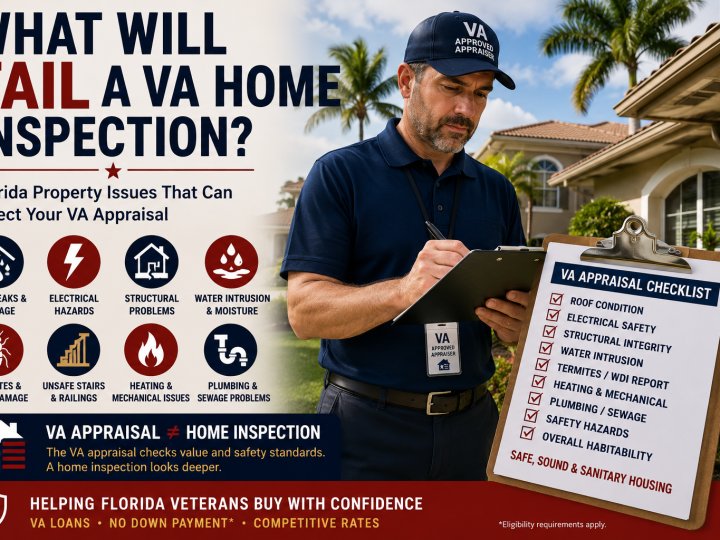
The VA appraisal has two major jobs: support value and identify property conditions that visibly conflict with VA Minimum Property Requirements. VA handbook guidance says these requirements help ensure that the property is safe, structurally sound, and sanitary. It also distinguishes the appraisal from a full home inspection. A home inspection can still be a valuable buyer decision even though it is separate from the VA appraisal.
VA Minimum Property Requirements
While every home is different, the property must be suitable as residential collateral and meet the VA’s condition standards before the guaranty. Items that may matter include access, utilities, roof condition, defective conditions, water and sanitary facilities, environmental concerns, and regional requirements. If an appraisal is completed subject to repairs, the required repairs usually need resolution before closing.
South Florida property realities
Florida homebuyers also need to think locally. In Palm Beach, Broward, Miami-Dade, and St. Lucie counties, insurance availability, wind exposure, flood-zone status, and association requirements can materially affect the total housing payment or documentation process. Those are not reasons to avoid a VA purchase. They are reasons to review the specific property carefully before assuming a monthly payment or closing timeline.
Buyers who want a broader purchase roadmap may also find the firm’s homebuying steps guide useful when turning eligibility into an actual search plan.
Down payment, funding fee, and closing costs
VA-backed purchase financing is well known for allowing eligible borrowers to buy with no down payment in many cases, but that does not mean every transaction is cash-free. Buyers should understand the funding fee, allowed closing costs, prepaids, taxes, insurance, reserves when relevant, and any negotiated seller credits before deciding how much cash to keep available.
The VA funding fee
The VA describes the funding fee as a one-time payment that helps lower program cost to taxpayers because VA home loans do not require down payments or monthly mortgage insurance. The fee depends on factors such as loan purpose, use history, down payment amount, and exemption status. VA funding-fee guidance also lists exemption categories, including certain borrowers receiving or eligible for compensation for a service-connected disability, certain surviving spouses receiving Dependency and Indemnity Compensation, qualifying pre-discharge ratings, and active-duty Purple Heart recipients who provide evidence by closing.
Because rates and exemptions can change or depend on file details, use current VA guidance and your loan estimate rather than relying on an old fee example.
Closing cost planning
Even when a down payment is not required, the transaction may still include closing costs and prepaid items. Ask for a clear estimate early. If you are testing affordability, avoid focusing only on principal and interest. South Florida insurance, escrow requirements, and property-specific items can shift the real monthly picture.
A practical VA loan checklist before house hunting
- Confirm the target use is a primary residence that fits occupancy intent.
- Request or review the Certificate of Eligibility.
- Organize income, asset, military, and identity documentation.
- Review credit reports for errors or avoidable issues.
- Discuss entitlement questions if you previously used a VA home loan.
- Estimate payment with taxes, homeowners insurance, possible flood insurance, and association dues where relevant.
- Ask how the VA appraisal and any property-condition questions could affect timing.
- Get a pre-approval conversation started before relying on a target price point.
- Write down property questions before touring so mortgage, insurance, and appraisal conversations stay connected.
Want a VA-focused mortgage consultation for a Florida purchase? Start your application or contact the team.
Questions to ask before making an offer
Pre-approval is helpful, but an offer decision still needs property-specific judgment. Before you commit, ask whether the home’s condition could create VA appraisal repairs, whether insurance quotes match the budget you modeled, and whether flood-zone or association documentation may need extra lead time. In South Florida, these details can influence the total payment just as much as the sale price.
It also helps to separate eligibility from affordability. A borrower may be eligible for a VA benefit and still decide that a different price point, property type, or timeline is financially stronger. A thoughtful review can keep the search focused on homes that fit the benefit, the payment, and the closing schedule.
FAQ: VA loan requirements
Do VA loan requirements include a Certificate of Eligibility?
Yes. A COE documents that the VA recognizes your benefit eligibility. It does not replace underwriting, but it is a central part of the VA mortgage process.
Does the VA set every credit rule?
No. The VA states that borrowers must meet credit and income requirements from both the VA and the lender. Your full credit profile and repayment ability still matter.
Can a VA loan be used for a Florida vacation home?
A VA purchase loan is built around occupancy as a residence. The VA handbook says the borrower must certify intent to personally occupy the home, subject to the program’s occupancy rules and limited exceptions.
Is a VA appraisal the same as a home inspection?
No. VA Minimum Property Requirements are reviewed through the appraisal process, but VA guidance says the appraisal is not a home inspection. Buyers may still choose a separate inspection for a fuller view of property condition.
Do all eligible borrowers pay the VA funding fee?
No. The VA lists exemption categories, including certain borrowers with qualifying service-connected disability compensation status and some surviving spouses. Exemption status should be verified for the specific borrower.
Why do Florida veterans need to plan for insurance early?
Insurance and flood-zone questions can affect the total projected payment, required documentation, and property fit. In coastal and storm-exposed markets, that review belongs near the front of affordability planning.
Turn VA eligibility into a clear Florida buying plan
VA loan requirements are easier to manage when they are handled in order. Start with eligibility and the COE, prepare for credit and income review, understand occupancy and property rules, and evaluate the true monthly cost of the Florida home you want. Mortgages Done Right helps buyers across South Florida translate mortgage questions into a practical next step, whether you are still confirming eligibility or preparing for a specific property.
For more general process answers, visit the mortgage FAQ page, then reach out when you are ready to talk through your file.