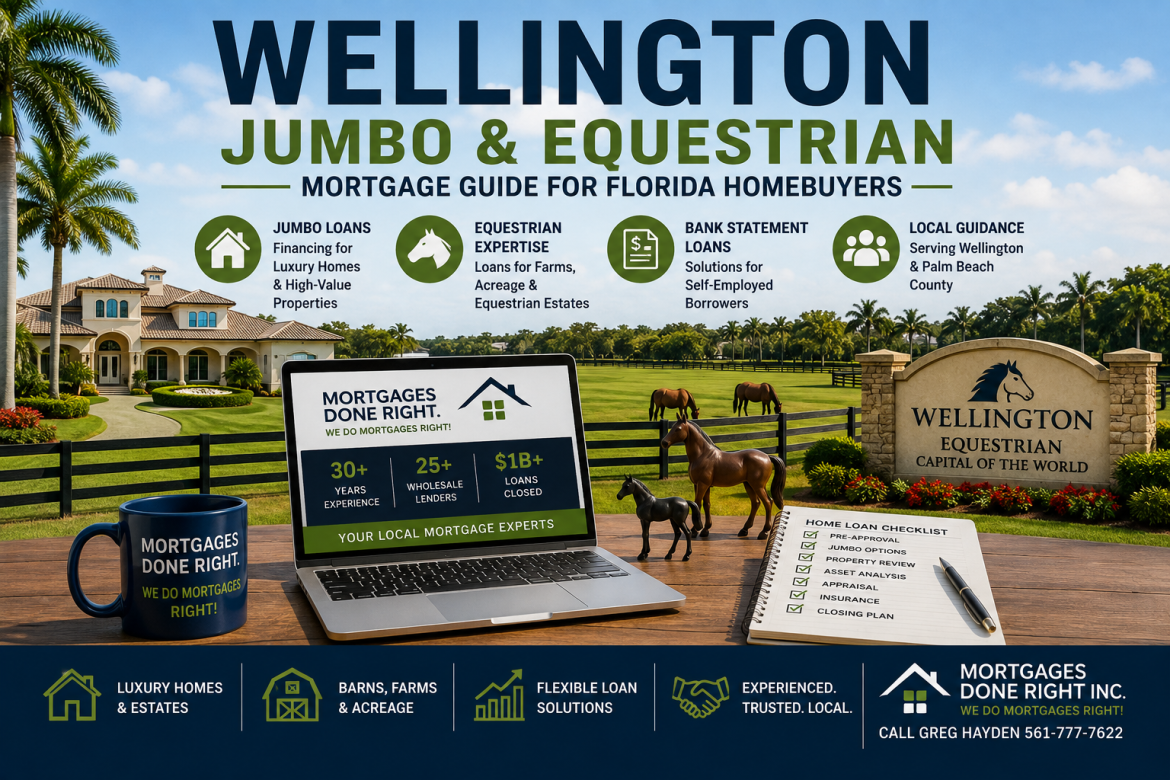
If you are researching a Wellington jumbo mortgage, financing a luxury home or equestrian property can require a different approach than financing a typical suburban residence. Higher loan amounts, acreage, barns, riding facilities, property uniqueness, self-employed income and substantial reserve requirements can all affect the mortgage strategy.
Wellington is unlike most South Florida communities. Its approximately 9,000-acre Equestrian Preserve Area includes farms, equestrian facilities, bridle trails and major competition venues, while the broader community also includes luxury neighborhoods, gated communities and traditional single-family homes.
Mortgages Done Right Inc. works with more than 25 wholesale lenders and helps qualified borrowers compare jumbo, conventional, bank statement and other mortgage options based on the borrower and the specific property.
For our primary local resource, visit our Wellington mortgage broker page. You can also explore mortgage information throughout the county on our Palm Beach County mortgage broker page.
Why Wellington Jumbo Mortgage Financing Can Be Different
Jumbo mortgage financing generally becomes relevant when the required loan amount exceeds the applicable conforming loan limit.
But loan size is only part of the Wellington financing picture.
Luxury and equestrian transactions can involve:
- Higher purchase prices and larger loan amounts
- Substantial borrower reserve requirements
- Multiple income sources
- Business-owner or self-employed income
- Large investment portfolios
- Acreage
- Barns and equestrian improvements
- Guest houses or additional structures
- Unique property characteristics
- More complex appraisals
Because jumbo lenders can have different underwriting requirements, a borrower or property that does not fit one lender’s guidelines may fit another lender differently.
Wellington’s Equestrian Property Market
Wellington has one of the most established equestrian communities in the country.
The Village of Wellington identifies an approximately 9,000-acre Equestrian Preserve Area in the western and southern portions of the community. It includes Wellington International, the National Polo Center, public and private bridle trails, farms and other equestrian facilities.
The internationally known Winter Equestrian Festival also brings major show-jumping competition to Wellington each winter.
For mortgage purposes, this matters because an equestrian property can be considerably different from a standard single-family residence.
What Makes an Equestrian Property Different for a Mortgage?
A lender evaluating a Wellington equestrian property may need to consider more than the primary residence.
Depending on the property and loan program, characteristics may include:
- Several acres of land
- Horse barns
- Stalls
- Paddocks
- Riding arenas
- Bridle access
- Groom or staff quarters
- Guest houses
- Storage buildings
- Specialized equestrian improvements
The existence of these features does not automatically prevent residential mortgage financing. However, the lender must determine that the property satisfies its residential lending guidelines and that the appraisal adequately supports the collateral.
Residential Use vs. Business Use
One important consideration with an equestrian property is how the property is actually being used.
A private residence with horses for the owner’s personal use can present a different mortgage scenario from a property operating as a significant commercial boarding, training, breeding or equestrian business.
The amount and nature of business activity can affect which lenders and loan programs may consider the property.
Borrowers purchasing a property with significant commercial characteristics should discuss the intended use early in the mortgage process rather than waiting until appraisal or underwriting.
Appraising a Wellington Equestrian Property
Appraisal can be especially important with unusual luxury and equestrian properties.
A traditional home in a subdivision may have numerous nearby comparable sales. A customized equestrian estate with acreage, barns, arenas and specialized improvements may have fewer truly comparable properties.
The appraiser may need to evaluate:
- Location
- Lot size and acreage
- Main residence
- Condition and quality
- Additional structures
- Equestrian improvements
- Recent comparable sales
- Market acceptance of the property’s features
A high purchase price alone does not guarantee an equivalent appraised value. The lender ultimately relies on an acceptable appraisal and its own collateral requirements.
Jumbo Mortgage Options for Wellington Buyers
Borrowers purchasing higher-value Wellington properties may have several potential jumbo structures available depending on qualifications and lender guidelines.
Learn more on our Florida jumbo loan page.
Jumbo lenders may evaluate:
- Credit profile
- Debt-to-income ratio
- Down payment
- Cash reserves
- Income documentation
- Property type
- Occupancy
- Appraised value
- Loan amount
Requirements vary substantially among lenders. That is one reason comparing multiple wholesale lenders can be useful on higher-value transactions.
How Much Down Payment Does a Wellington Jumbo Loan Require?
There is no single down-payment requirement that applies to every jumbo mortgage.
The amount can vary according to:
- Loan amount
- Borrower credit
- Property type
- Occupancy
- Income documentation
- Available reserves
- Specific lender guidelines
Some borrowers may choose to make a larger down payment even when a lower-down-payment structure is available, while others may prefer to preserve liquidity for investments, business needs, equestrian expenses or reserves.
The best structure should be evaluated based on the borrower’s complete financial picture rather than down payment alone.
Reserve Requirements on Jumbo Mortgages
Jumbo lenders may require borrowers to demonstrate substantial assets remaining after closing.
These reserves provide evidence that the borrower has additional financial resources after paying the down payment and closing costs.
Depending on lender guidelines, acceptable assets may include certain:
- Checking and savings accounts
- Investment accounts
- Retirement accounts
- Other eligible liquid or financial assets
The required reserve amount varies by lender, loan amount, property and borrower profile.
Self-Employed Wellington Homebuyers
Wellington’s luxury and equestrian market includes business owners, professionals, investors and other borrowers whose finances may be more complex than a traditional salaried employee.
Being self-employed does not automatically require an alternative-documentation mortgage.
The first step should generally be determining whether the borrower qualifies using conventional or jumbo income calculations.
When traditional tax-return income does not appropriately fit the borrower’s circumstances, eligible borrowers may be able to consider Florida bank statement mortgage programs.
Bank Statement Loans for Wellington Business Owners
A bank statement mortgage may allow an eligible self-employed borrower to qualify using an analysis of qualifying bank deposits rather than relying solely on traditional tax-return income.
These programs can be useful in certain situations where legitimate business deductions reduce taxable income.
However, bank statement loans are not automatically better than traditional mortgages. Rates, down payments, reserves, documentation and underwriting requirements can differ.
A borrower should compare traditional and alternative-documentation options before deciding which structure makes sense.
Using Investment Assets in Jumbo Qualification
Some high-net-worth borrowers hold substantial assets but have income structures that do not resemble a typical W-2 employee.
Depending on the lender and program, qualification may involve evaluation of:
- Employment income
- Business income
- Investment income
- Retirement income
- Eligible financial assets
- Other documented qualifying income
Guidelines vary by lender. Complex borrowers should have their income and asset structure reviewed before making assumptions about which jumbo program will work.
Second Homes in Wellington
Some buyers spend only part of the year in Wellington, particularly during the equestrian season.
A qualifying second-home mortgage can differ from financing a primary residence or investment property.
The borrower’s intended occupancy should be discussed accurately at the beginning of the mortgage process because occupancy affects lender guidelines, pricing and eligibility.
A property primarily intended to generate rental income generally should not be represented as a second home merely to obtain different financing terms.
Investment and Rental Properties
Wellington’s seasonal market can also attract real estate investors.
Depending on the borrower and property, investment financing may include conventional investment-property mortgages or specialized programs such as DSCR investor loans.
DSCR programs may evaluate qualifying rental income relative to the property’s debt obligations rather than relying exclusively on traditional personal-income documentation.
Program availability and property eligibility vary by lender.
Estimate Your Wellington Mortgage Payment
With a higher-value property, even relatively small changes in the loan amount or interest rate can materially affect the monthly principal-and-interest payment.
Use our Florida mortgage calculator to compare estimated payments using different loan amounts and interest-rate assumptions.
For a Wellington luxury or equestrian property, remember that the mortgage payment may be only one component of the complete cost of ownership.
Additional expenses can include:
- Property taxes
- Homeowners insurance
- Flood or wind coverage where applicable
- HOA expenses
- Property maintenance
- Pool and landscaping expenses
- Equestrian facility maintenance
- Barn and acreage expenses
The calculator provides estimates only and does not constitute a mortgage quote or approval.
Florida Homeowners Insurance and Luxury Properties
Insurance should be investigated early when purchasing a higher-value Wellington property.
Large homes, unique construction, acreage and additional structures can affect insurance availability and premiums.
The lender will generally need acceptable insurance coverage before closing, and the premium can affect the borrower’s total housing expense used during qualification.
Buyers should consider obtaining insurance information while evaluating the property rather than waiting until immediately before closing.
Property Taxes on Higher-Value Wellington Homes
Buyers should not assume that the seller’s existing property-tax bill will necessarily equal their future tax obligation.
Changes in ownership, assessed value and exemptions can affect future property taxes.
This becomes especially important when estimating the complete carrying cost of a higher-value property.
Use a realistic projected tax amount when determining affordability rather than relying only on the seller’s current bill.
Getting Pre-Approved for a Wellington Jumbo Mortgage
A thorough jumbo pre-approval can be particularly useful before making an offer on a luxury or equestrian property.
The review may include:
- Income. Employment, business, investment or other qualifying income.
- Assets. Funds for the down payment, closing costs and required reserves.
- Credit. Credit history and existing obligations.
- Property type. Traditional residence, luxury home, acreage or equestrian estate.
- Occupancy. Primary residence, qualifying second home or investment property.
- Loan amount. The requested mortgage relative to applicable lender guidelines.
- Insurance. Estimated property-insurance costs.
A pre-approval is not a guarantee of final mortgage approval. The property, appraisal, title, insurance and final underwriting must still satisfy applicable requirements.
Questions to Ask Before Financing a Wellington Equestrian Home
Before making an offer, consider asking your mortgage professional:
- Does the lender accept this amount of acreage?
- How will barns and equestrian improvements be evaluated?
- Could the property’s current use be considered commercial?
- What jumbo loan options are available?
- How much down payment may be required?
- What reserve requirements apply?
- How will my self-employed income be calculated?
- Should we compare a traditional jumbo loan with a bank statement program?
- Could the property’s uniqueness make the appraisal more complex?
- What insurance information should I obtain before closing?
These questions are easier to address before signing a contract than after the transaction is already approaching its financing deadline.
Mortgage Services Near Wellington
Mortgages Done Right serves borrowers throughout western Palm Beach County and surrounding communities.
Explore nearby mortgage resources:
- Royal Palm Beach mortgage broker
- Loxahatchee, The Acreage and Loxahatchee Groves mortgage broker
- West Palm Beach mortgage broker
- Palm Beach mortgage broker
For countywide mortgage information, visit our Palm Beach County mortgage broker guide.
Why Work With Mortgages Done Right?
Greg Hayden and Mortgages Done Right Inc. bring more than 30 years of mortgage experience to Florida homebuyers, homeowners and real estate investors.
Mortgages Done Right works with more than 25 wholesale lenders and has closed more than $1 billion in mortgage volume over Greg’s career.
For a Wellington luxury or equestrian transaction, access to multiple lenders can be particularly useful because jumbo, acreage, property and income guidelines can differ substantially among lenders.
Frequently Asked Questions About Wellington Jumbo Mortgages
What is a jumbo mortgage?
A jumbo mortgage generally refers to a mortgage with a loan amount above the applicable conforming loan limit. Jumbo loans are not purchased under the standard conforming framework and can have different lender requirements.
Can I finance an equestrian property in Wellington?
Potentially. Financing depends on the borrower, property, intended use, appraisal and lender guidelines. Acreage, barns and other equestrian improvements should be discussed with the lender early in the process.
Does having a barn prevent residential mortgage financing?
Not automatically. The lender will evaluate the entire property and its use. Significant commercial activity or unusual property characteristics may limit which residential loan programs are appropriate.
Can self-employed borrowers qualify for jumbo mortgages?
Yes. Self-employed borrowers can qualify for jumbo financing when they satisfy the lender’s income, credit, asset and other underwriting requirements.
What if my tax returns do not show enough qualifying income?
First determine whether traditional mortgage calculations work. Eligible self-employed borrowers may also have access to alternative programs such as bank statement loans, depending on lender guidelines.
Can I finance a Wellington home as a second home?
Potentially, if the borrower and property satisfy the lender’s second-home requirements and the property will genuinely be used as a qualifying second residence.
Do jumbo mortgages require large cash reserves?
Many jumbo programs require borrowers to document assets remaining after closing. The amount varies according to lender, loan amount, property and borrower profile.
Why can an equestrian appraisal be more complicated?
Highly customized properties with acreage, barns, arenas or other specialized improvements may have fewer directly comparable sales than typical subdivision homes, which can make valuation more complex.
Should I get pre-approved before making an offer?
Yes, a detailed pre-approval can help identify potential income, asset, loan-size or property issues before an offer is submitted. Pre-approval does not guarantee final mortgage approval.
Talk With a Wellington Mortgage Broker
If you are purchasing a luxury home, equestrian estate or other property in Wellington, Mortgages Done Right can help you compare mortgage options from more than 25 wholesale lenders.
Contact Greg Hayden or call 561-777-7622 to discuss your financing goals.
If you are ready to begin, you can also start your mortgage application online.
Important disclaimer: Jumbo loan limits, mortgage rates, loan programs, down-payment requirements, reserve requirements, appraisal standards, property eligibility, insurance costs and lender guidelines can change. Equestrian and acreage properties are evaluated individually, and not every residential lender or loan program will accept every property type or use. This article is educational and does not constitute a commitment to lend or a guarantee of approval, rate or terms. Final eligibility and pricing depend on the borrower, property, appraisal, loan program, lender and market conditions at the time of application.