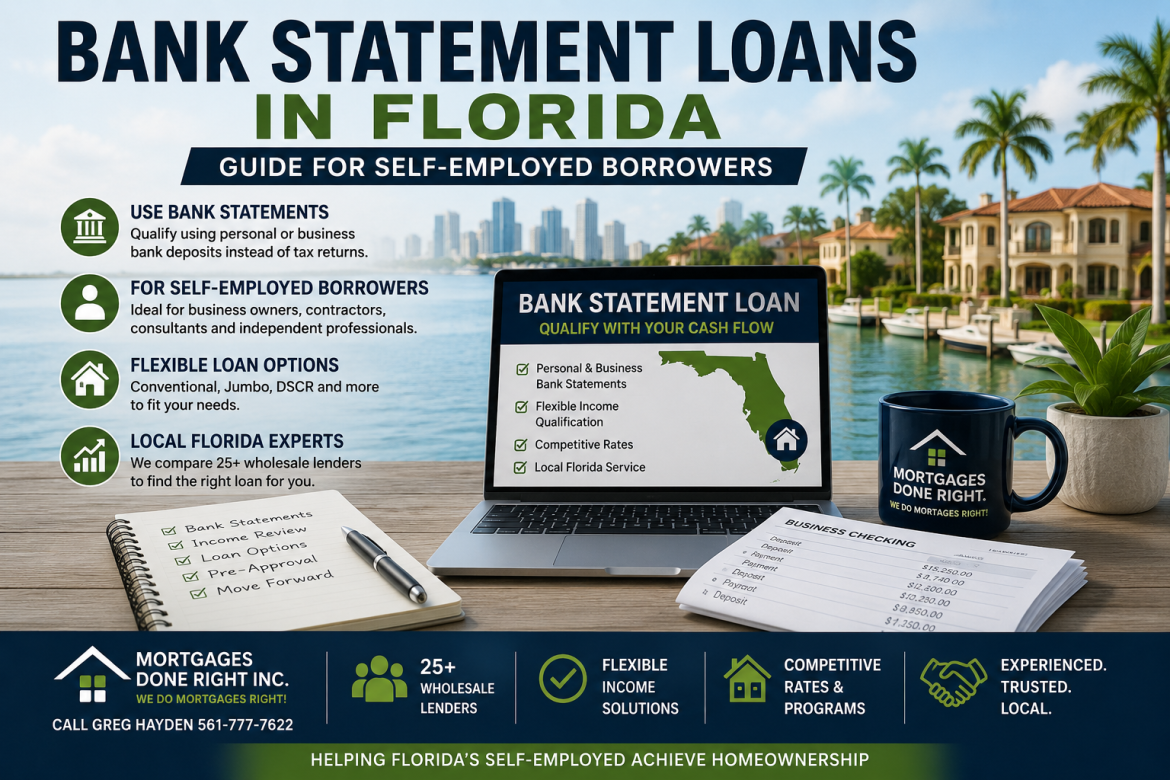
If you are researching bank statement loans in Florida, you may be self-employed, own a business or earn income that is not fully reflected by the taxable income shown on your traditional tax returns. For some qualified borrowers, a bank statement mortgage can provide an alternative way to document income when conventional underwriting does not accurately reflect cash flow.
Florida has a large population of business owners, independent contractors, consultants, real estate professionals and other self-employed borrowers. These borrowers may have legitimate business deductions that reduce taxable income while their bank deposits demonstrate substantially different cash flow.
Mortgages Done Right Inc. works with more than 25 wholesale lenders and helps qualified Florida borrowers compare bank statement, conventional, jumbo, DSCR and other mortgage options based on their income, property and financing goals.
For a detailed overview of this loan program, visit our Florida bank statement loan page.
What Are Bank Statement Loans in Florida?
A bank statement loan is a type of non-QM mortgage that may allow qualified borrowers to document income using eligible personal or business bank statements instead of relying solely on traditional tax-return income calculations.
The lender reviews deposits over a specified period and applies its underwriting guidelines to determine qualifying income. The exact calculation depends on the lender, whether personal or business statements are being used, the type of business and applicable expense factors.
Bank statement loans are not no-documentation loans. Borrowers still must satisfy the lender’s credit, asset, property, down payment and other underwriting requirements.
Who May Benefit From a Florida Bank Statement Mortgage?
Bank statement financing can be particularly useful for self-employed borrowers whose tax returns may not present the complete picture of their business cash flow.
Potential borrowers may include:
- Business owners
- Independent contractors
- Consultants
- Real estate professionals
- Commission-based professionals
- Freelancers
- Entrepreneurs
- Other qualified self-employed borrowers
The right mortgage should be determined by the borrower’s complete financial profile. Some self-employed borrowers may still qualify for a traditional conventional mortgage, so it is important to compare available options rather than automatically assuming a bank statement loan is necessary.
How Do Bank Statement Lenders Calculate Income?
Income calculations can vary significantly among lenders. This is one reason comparing multiple wholesale lenders can be valuable for a self-employed borrower.
A lender may review eligible deposits appearing on personal or business bank statements over the required period. Transfers, unusual deposits and other non-income items may need to be identified or excluded depending on the program.
When business bank statements are used, the lender may also apply an expense factor when determining qualifying income. Different lenders can have different documentation requirements and methods for evaluating the borrower’s business.
Because guidelines vary, two lenders reviewing the same borrower may not necessarily arrive at exactly the same qualifying income.
Bank Statement Loans for Florida Business Owners
Florida business owners often deduct legitimate business expenses when filing tax returns. Those deductions can reduce taxable income, which may make conventional mortgage qualification more difficult even when the business produces strong cash flow.
A bank statement mortgage may provide another way for an eligible borrower to demonstrate income. However, lenders still evaluate the overall strength of the application, including credit history, assets, reserves, down payment and the property being financed.
Borrowers should not alter tax or accounting decisions solely to qualify for a mortgage. Tax questions should be discussed with a qualified tax professional.
Bank Statement Jumbo Loans in Florida
Bank statement financing can also be relevant for borrowers purchasing higher-priced Florida properties. A self-employed borrower may need both alternative income documentation and a larger mortgage amount.
Depending on the transaction and lender guidelines, borrowers may be able to compare a bank statement program with other Florida jumbo loan options.
This can be particularly relevant in higher-value South Florida markets where purchase prices and required loan amounts may exceed conventional financing parameters.
Bank Statement Loans vs. DSCR Loans
Bank statement and DSCR loans solve different mortgage qualification problems.
A bank statement mortgage is generally designed for an owner-occupied or otherwise eligible property transaction where the borrower’s qualifying income is evaluated using bank statements under the lender’s guidelines.
A DSCR investor loan is generally designed for qualifying investment properties and focuses more heavily on the property’s rental income and debt-service coverage rather than the borrower’s traditional personal income.
A self-employed borrower purchasing a primary residence may therefore consider bank statement financing, while a real estate investor purchasing a rental property may find a DSCR program more appropriate.
How Much Down Payment Is Required?
There is no single down payment requirement that applies to every Florida bank statement loan. Requirements vary by lender and can depend on credit profile, loan amount, occupancy, property type and other risk factors.
Borrowers should compare the complete financing structure rather than focusing only on the advertised interest rate. Down payment, lender fees, reserves, mortgage insurance when applicable and long-term financing goals can all affect the overall cost of a mortgage.
Credit and Reserve Requirements
Bank statement loans generally require borrowers to meet lender-specific credit standards. Better credit and a stronger overall financial profile may provide access to more favorable program choices.
Lenders may also require borrowers to maintain reserves after closing. Reserve requirements can become especially important with larger loan amounts, multiple financed properties or more complex borrower profiles.
Before making an offer, borrowers can use our Florida mortgage calculator to estimate potential principal-and-interest payments under different loan scenarios.
Bank Statement Loans in Palm Beach County
Bank statement financing can be especially relevant in Palm Beach County because the area includes a broad mix of entrepreneurs, professionals, investors and business owners purchasing everything from condominiums and single-family homes to luxury and equestrian properties.
Borrowers can explore our Palm Beach County mortgage broker guide for additional information about financing throughout the county.
We also provide local mortgage information for borrowers in Boca Raton, Delray Beach and Wellington, along with communities throughout South Florida.
Bank Statement Loans for Boca Raton and Delray Beach Buyers
Boca Raton and Delray Beach include luxury homes, condominiums, investment properties and a substantial population of business owners and self-employed professionals.
For borrowers with complex income, the mortgage strategy may involve comparing conventional financing against bank statement or jumbo alternatives. Property type, condominium requirements, insurance costs and the borrower’s income documentation can all influence the final loan structure.
Bank Statement Financing for Wellington Homebuyers
Wellington presents another unique market because borrowers may be purchasing luxury residences, equestrian properties, acreage or homes with features that require additional underwriting consideration.
A self-employed buyer purchasing a higher-value Wellington property may need a combination of flexible income documentation, substantial reserves and jumbo financing. Comparing lenders before submitting an offer can help identify potential documentation or property issues earlier in the process.
What Documents Might a Bank Statement Borrower Need?
Documentation requirements vary by lender and loan program, but borrowers should be prepared to provide information necessary to verify their business, assets, deposits and overall financial profile.
Depending on the program, documentation may include:
- Personal or business bank statements for the required period
- Identification and standard mortgage application documentation
- Evidence of business ownership or self-employment
- Asset statements
- Documentation regarding unusual or large deposits when required
- Property and purchase-contract information
- Additional lender-specific documentation
Providing complete documentation early can help the lender determine whether a bank statement program is appropriate before the borrower gets too far into a purchase transaction.
Why Compare Multiple Bank Statement Lenders?
Non-QM underwriting guidelines are not identical from lender to lender. One lender may calculate business income differently, require different reserves or have different guidelines for credit, property type or loan size.
That makes lender comparison particularly important for borrowers with nontraditional income.
Mortgages Done Right Inc. works with more than 25 wholesale lenders, allowing qualified borrowers to compare multiple mortgage programs rather than being limited to the products offered by a single bank.
Bank Statement Loan Frequently Asked Questions
Do bank statement loans require tax returns?
Some bank statement programs may allow qualifying income to be determined without using traditional tax-return income calculations. Documentation requirements vary by lender, and additional tax or business documentation may still be required in certain situations.
Are bank statement loans only for business owners?
They are commonly used by self-employed borrowers and business owners, but eligibility depends on the specific lender and program guidelines.
Can I use business bank statements?
Some programs permit eligible business bank statements. The lender may apply an expense factor or other calculation when determining qualifying income.
Can a bank statement loan be used for a luxury home?
Potentially. Some lenders offer bank statement programs for larger loan amounts, subject to their jumbo, credit, down payment, reserve, property and other underwriting requirements.
Is a bank statement loan the same as a DSCR loan?
No. Bank statement programs generally evaluate borrower income using eligible bank statements, while DSCR loans are generally designed for investment properties and evaluate the property’s ability to support its mortgage debt under lender guidelines.
Are bank statement mortgage rates higher than conventional rates?
Rates and pricing depend on market conditions, borrower qualifications, loan structure and lender guidelines. Non-QM loans may be priced differently from conventional mortgages, so borrowers should compare the complete loan terms rather than assuming the programs will cost the same.
Talk With a Florida Mortgage Broker About Bank Statement Loans
If you are self-employed and your tax returns do not fully reflect the cash flow available to qualify for a mortgage, a bank statement loan may be worth evaluating.
Mortgages Done Right Inc. can help qualified borrowers compare bank statement loans with conventional, jumbo, DSCR and other available mortgage programs from participating wholesale lenders.
Call Greg Hayden and Mortgages Done Right Inc. at 561-777-7622 or contact us online to discuss your mortgage scenario.
You can also apply online when you are ready to begin.
Important: Mortgage programs, rates, loan limits, down payment requirements, income calculations, reserve requirements and underwriting guidelines are subject to change and vary by lender and borrower qualifications. This article is for general educational purposes and is not a commitment to lend, tax advice or a guarantee of qualification. Consult appropriate tax or financial professionals regarding your individual circumstances.