DSCR Loan Requirements for Florida Investors
DSCR loan requirements are important for Florida real estate investors who want to qualify for rental-property financing based primarily on the property’s cash flow rather than traditional personal income documentation.
A Debt Service Coverage Ratio loan, commonly called a DSCR loan, may be useful for experienced landlords, self-employed investors, LLC borrowers, and buyers building rental-property portfolios throughout Florida.
Want to review a rental-property scenario before you make an offer? Start an application with Mortgages Done Right or contact Greg Hayden to review the property, estimated rent, insurance, taxes, and projected payment.
DSCR loan requirements in Florida: lenders generally evaluate the subject property’s rental income, proposed housing expense, borrower credit profile, available down payment or equity, reserves, property type, and overall transaction. DSCR programs may reduce reliance on personal tax returns or W-2 income, but they are not no-documentation loans.
What Is a DSCR Loan?
A DSCR loan is an investment-property mortgage that evaluates whether qualifying rental income can support the housing expense used by the loan program.
DSCR stands for Debt Service Coverage Ratio.
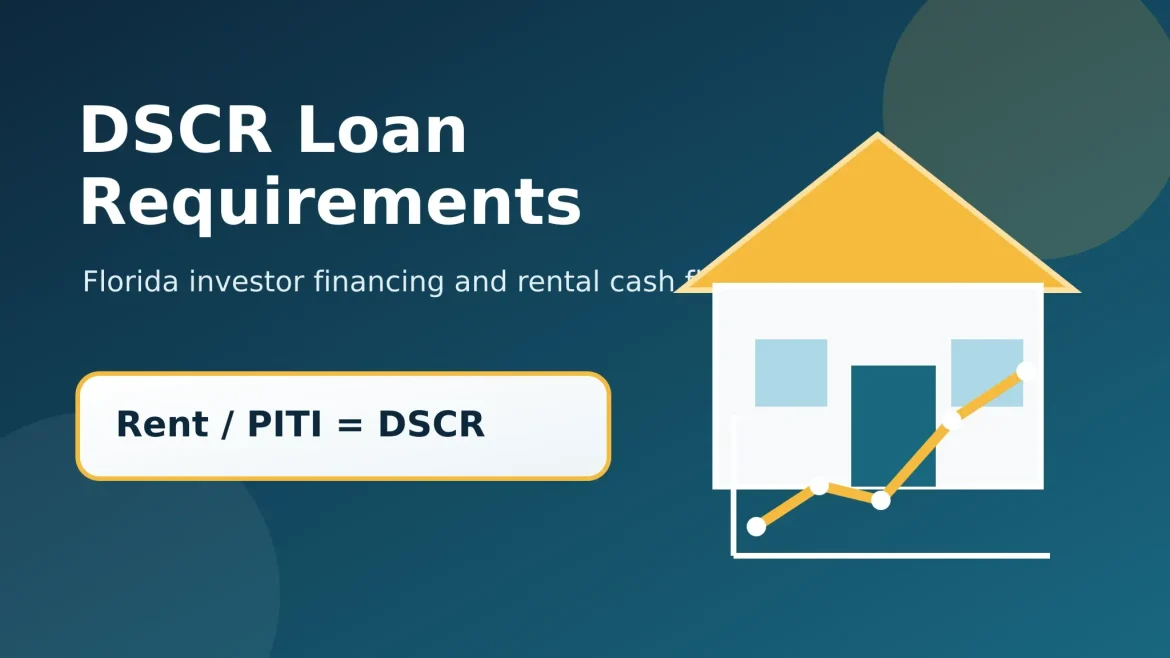
A simplified planning formula is:
Qualifying Monthly Rent ÷ Monthly Property Obligation = DSCR
For example, if qualifying rent is $3,250 per month and the applicable monthly property obligation is $3,000:
$3,250 ÷ $3,000 = 1.08 DSCR
A ratio above 1.00 generally means the qualifying rent exceeds the payment used in the calculation. A ratio of 1.00 means the two amounts are approximately equal. A ratio below 1.00 means the payment exceeds the qualifying rent.
Exact calculation methods and minimum acceptable ratios vary by lender and program.
For a complete overview of the program, visit our main Florida DSCR investor loan page.
What Expenses Are Included in a DSCR Calculation?
The housing obligation used for DSCR qualification may include several property expenses, depending on the lender and program.
Common components can include:
- Principal and interest
- Property taxes
- Homeowners or hazard insurance
- Flood insurance when applicable
- Condominium or homeowners association dues
- Other property-related expenses required by the program
This is particularly important in Florida because property taxes, homeowners insurance, flood insurance, and association expenses can materially affect the ratio.
DSCR Loan Requirements at a Glance
| Requirement Area | What Florida Investors Should Review |
|---|---|
| DSCR Ratio | The property’s qualifying rental income is compared with the applicable monthly housing obligation. Minimum ratios vary by lender and program. |
| Credit Profile | Credit score, payment history, mortgage history, and overall borrower profile can affect eligibility, pricing, and leverage. |
| Down Payment or Equity | Required equity varies according to lender, credit, DSCR ratio, property type, transaction, and loan amount. |
| Cash Reserves | Lenders may require liquid assets remaining after closing to help cover vacancies, repairs, and mortgage payments. |
| Property Eligibility | Eligible property types can include certain single-family rentals, condos, townhomes, and multi-unit investment properties, subject to lender guidelines. |
| Income Documentation | DSCR programs may reduce reliance on personal employment income and tax returns, but property, asset, credit, and transaction documentation is still required. |
How Do You Calculate DSCR for a Florida Rental Property?
The calculation begins with the qualifying rental income accepted by the lender.
Depending on the transaction, rent documentation may include:
- An existing lease
- Appraiser-supported market rent
- A rental schedule included with the appraisal
- Other documentation accepted by the specific lender
The qualifying rent is then compared with the property obligation required by that DSCR program.
Example DSCR Calculation
- Qualifying monthly rent: $3,250
- Principal and interest: $2,150
- Property taxes: $420
- Property insurance: $310
- HOA dues: $120
- Total illustrated monthly obligation: $3,000
$3,250 ÷ $3,000 = 1.08 DSCR
In this example, the qualifying rental income is approximately 8% greater than the illustrated monthly obligation.
That does not guarantee loan approval. If insurance is higher than expected, property taxes increase after purchase, association dues change, or accepted market rent is lower, the resulting DSCR can also change.
For more detail, read our DSCR loan calculator guide for Florida investors.
How Much Down Payment Is Required for a DSCR Loan?
There is no single down-payment requirement that applies to every DSCR loan.
Many investor programs require more equity than a typical owner-occupied mortgage. Available leverage can depend on:
- Credit score
- DSCR ratio
- Purchase versus refinance
- Cash-out versus rate-and-term refinance
- Property type
- Loan amount
- Number of units
- Borrower experience
- Reserve levels
- Current lender guidelines
In some scenarios, investors may see down-payment requirements around 20% to 25%, while other transactions may require more or allow different leverage. The actual requirement must be determined from the specific lender and property scenario.
What Credit Score Is Needed for a DSCR Loan?
Credit requirements also vary substantially between lenders.
Some DSCR programs may be available to borrowers with credit scores in the upper-600 range, while stronger credit can improve available pricing, leverage, reserve requirements, and overall program choices.
Instead of focusing on one minimum score, investors should evaluate the complete transaction because credit is only one piece of the approval.
Do DSCR Loans Require Cash Reserves?
Many DSCR lenders require borrowers to maintain liquid reserves after closing.
Reserve requirements may depend on:
- Loan amount
- Property type
- Number of financed properties
- Credit profile
- DSCR ratio
- Transaction type
- Investor experience
- Lender guidelines
Maintaining reserves can also be financially prudent for investors because rental properties can experience vacancies, repairs, insurance changes, association assessments, and other unexpected costs.
What Documents Are Needed for a DSCR Loan?
DSCR financing can reduce reliance on personal income documentation, but it is not a documentation-free mortgage.
Depending on the transaction, investors may need:
- Government-issued identification
- Entity or LLC documentation when applicable
- Purchase contract
- Existing mortgage payoff information for refinances
- Asset statements for down payment, closing costs, and reserves
- Current lease documentation where applicable
- Property appraisal
- Market-rent analysis
- Insurance information
- Condo or HOA documentation where applicable
- Additional property or borrower documentation required by the lender
Can Self-Employed Investors Use DSCR Financing?
Yes. DSCR loans can be particularly useful for self-employed investors because qualification may focus primarily on the rental property’s cash flow rather than traditional personal income calculations.
This can help investors whose tax returns show significant business deductions or whose income is otherwise complex.
However, if the financing is for an owner-occupied home rather than a rental property, a Florida bank statement loan may be another option worth comparing.
Investors can also learn more about the broader category of Non-QM mortgage financing in Florida.
What Property Types May Be Eligible for DSCR Loans?
Property eligibility varies by lender, but DSCR financing may be available for certain:
- Single-family rental properties
- Townhomes
- Condominiums
- Two- to four-unit investment properties
- Long-term rental properties
- Certain short-term rental scenarios
Property condition, appraisal, market rent, insurance, association requirements, and lender guidelines all affect eligibility.
Larger or more specialized investment properties may instead require commercial real estate financing.
Can DSCR Loans Be Used for Purchases and Refinances?
Yes. Depending on the lender and borrower scenario, DSCR financing may be available for:
- Investment-property purchases
- Rate-and-term refinances
- Cash-out refinances
- Portfolio expansion
Purchase, refinance, and cash-out transactions may have different loan-to-value, reserve, seasoning, credit, and pricing requirements.
South Florida Factors That Can Change DSCR Qualification
DSCR investors in Palm Beach County, Broward County, Miami-Dade County, St. Lucie County, and throughout Florida should pay particular attention to property expenses.
Florida Insurance Costs
Homeowners insurance can materially affect the monthly housing obligation used for qualification.
Older homes, coastal properties, flood zones, condos, and properties with wind-related exposure may require additional review.
A realistic insurance quote is much more useful than a generic online estimate when evaluating a potential investment.
Property Taxes After Purchase
The seller’s existing property-tax bill may not accurately represent what a new investor will pay after the transaction.
Investors should use a reasonable estimate of post-purchase taxes when testing cash flow rather than assuming the seller’s current bill will continue unchanged.
HOA and Condo Expenses
Association dues can materially change DSCR.
Investors should verify regular dues, known assessments, insurance issues, and property eligibility before assuming a condominium or HOA property will qualify.
Market Rent Must Be Supportable
The highest advertised rent in a neighborhood should not automatically be used as the expected qualifying rent.
Property condition, bedroom count, location, parking, amenities, rental strategy, and comparable rental activity can all affect market-rent support.
Common DSCR Loan Mistakes Florida Investors Should Avoid
-
Using unrealistic rent assumptions.
A property that only works with best-case rent may not produce the same DSCR when the appraisal is completed. -
Underestimating insurance.
Florida property insurance can materially change the projected payment. -
Using the seller’s tax bill without adjustment.
Property taxes may change after the sale. -
Ignoring association dues.
Condo and HOA expenses can reduce the property’s coverage ratio. -
Assuming DSCR means no documentation.
Assets, reserves, credit, appraisal, rent documentation, insurance, and transaction documents remain important. -
Using every available dollar to close.
Investors should consider the reserves needed after closing for vacancies and unexpected repairs. -
Waiting too long to review the financing.
Loan structure, vesting, entity requirements, cash-out objectives, and property eligibility should be reviewed early.
How to Prepare Before Applying for a DSCR Loan
-
Identify the transaction.
Determine whether you are purchasing, refinancing, or taking cash out. -
Estimate realistic rental income.
Use supportable market data rather than an optimistic target. -
Estimate the full property payment.
Include principal, interest, taxes, insurance, and applicable association expenses. -
Review your available funds.
Separate the cash needed for closing from reserves you intend to retain afterward. -
Gather property details.
Property type, unit count, lease status, HOA information, and insurance considerations can affect the program. -
Compare more than one lender.
DSCR guidelines can vary materially among lenders.
Start your DSCR loan application or contact Greg Hayden to review a Florida investment-property scenario.
DSCR Loan Requirements FAQ
What are the basic DSCR loan requirements?
Requirements generally include an eligible investment property, supportable rental income, acceptable credit, sufficient down payment or equity, required reserves, acceptable collateral, and transaction documentation. Exact requirements vary by lender.
Do DSCR loans require 20% down?
Not always. Some programs may allow approximately 20% to 25% down in certain purchase scenarios, while others may require different equity depending on credit, DSCR ratio, property type, loan amount, and lender requirements.
What DSCR ratio is required?
Minimum DSCR requirements vary by lender. Some programs prefer a ratio at or above 1.00, while stronger ratios may provide more program choices or better pricing. Other structures may exist for lower ratios depending on the lender.
Do DSCR loans require tax returns?
Many DSCR programs do not qualify the investment property primarily from the borrower’s personal tax-return income. However, the lender still requires documentation related to the property, assets, reserves, credit, appraisal, rent, and transaction.
Can a DSCR loan be made to an LLC?
Some DSCR programs permit eligible business entities such as LLCs. Vesting, guarantor, documentation, and entity requirements vary by lender.
Can I use a DSCR loan for a Florida rental property?
Yes. DSCR financing is designed for eligible investment-property transactions, subject to lender and property requirements.
What is the downside of a DSCR loan?
Depending on the transaction, DSCR financing may require more equity, reserves, or different pricing than traditional mortgage financing. Qualification also depends heavily on property economics, so insurance, taxes, association expenses, and lower-than-expected rent can affect eligibility.
Explore More Florida Investor Mortgage Resources
- Florida DSCR Investor Loans
- DSCR Loan Calculator Guide
- Non-QM Loans in Florida
- Bank Statement Loans for Self-Employed Borrowers
- Commercial Loans in Florida
Compare Florida DSCR Loan Options
DSCR loan requirements are best evaluated as a combination of property cash flow, collateral, borrower credit, equity, reserves, and the overall investment scenario.
The right lender can make a significant difference because DSCR ratios, minimum credit requirements, property guidelines, leverage, reserve requirements, and pricing vary between programs.
Greg Hayden and Mortgages Done Right Inc. can compare DSCR mortgage options from more than 25 wholesale lenders for Florida rental-property purchases and refinances.
Apply online, contact Greg Hayden, or call 561-777-7622 to discuss your Florida investment-property financing.
Loan programs, DSCR requirements, credit requirements, loan-to-value limits, reserve requirements, interest rates, pricing, property eligibility, documentation requirements, and availability are subject to lender guidelines and change. This article is for general informational purposes and is not a commitment to lend. Mortgages Done Right Inc. NMLS #1532755. Greg Hayden NMLS #332209.